FROM HIDDEN GEM TO STRATEGIC PARTNER: HOW SHR’S CRS STEPPED INTO THE SPOTLIGHT
CHALLENGE
SHR had a Central Reservation System that customers loved and rarely left, but the broader market didn’t know about it or what made it special until they spoke to someone from the organization. Their CRS page was generic and introductory, written to explain what a CRS is instead of the value of SHR’s approach. In a crowded category dominated by legacy vendors, the page didn’t clearly show that SHR’s CRS is actually a bundle of products, including booking engine, channel manager, GDS, and voice, and it didn’t speak directly to the lean hotel teams who benefit most from it.
SOLUTION
SHR and I partnered to define their sweet spot and sharpen the story around their CRS so it could finally match the quality of the product and the loyalty of their customers.
Packaging
A highlight of working with SHR was how strong their CRM data was with visibility into cross-product penetration. I was able to review their data and gain an understanding of what segments were purchasing which products, why through their win/loss data and customer stories, how that changed by region, and how that should inform our go-to-market plan. We ultimately decided to focus on two very clearly defined segments, one of which we would lead with only the CRS, and the other would lead with a bundle approach. And this was in addition to what was already a CRS bundle, which wasn’t clear from current materials.
Positioning
Then, based on that go-to-market strategy, I dug further into the competitive landscape. Most competitors were leading with design and generic efficiency claims, but SHR’s real strength is acting as an extension of the hotel’s team, while giving them enterprise‑level control and higher‑value bookings through automation and AI. That insight became the foundation of the positioning work.
Using a one‑page framework, we documented SHR’s market category, ideal customer profile, competitive set, distinct features, and unique value delivered. This made it clear that the CRS story needed to move away from basic education and toward a differentiated promise: more revenue and control for lean teams, backed by a partner that works alongside them.
Messaging
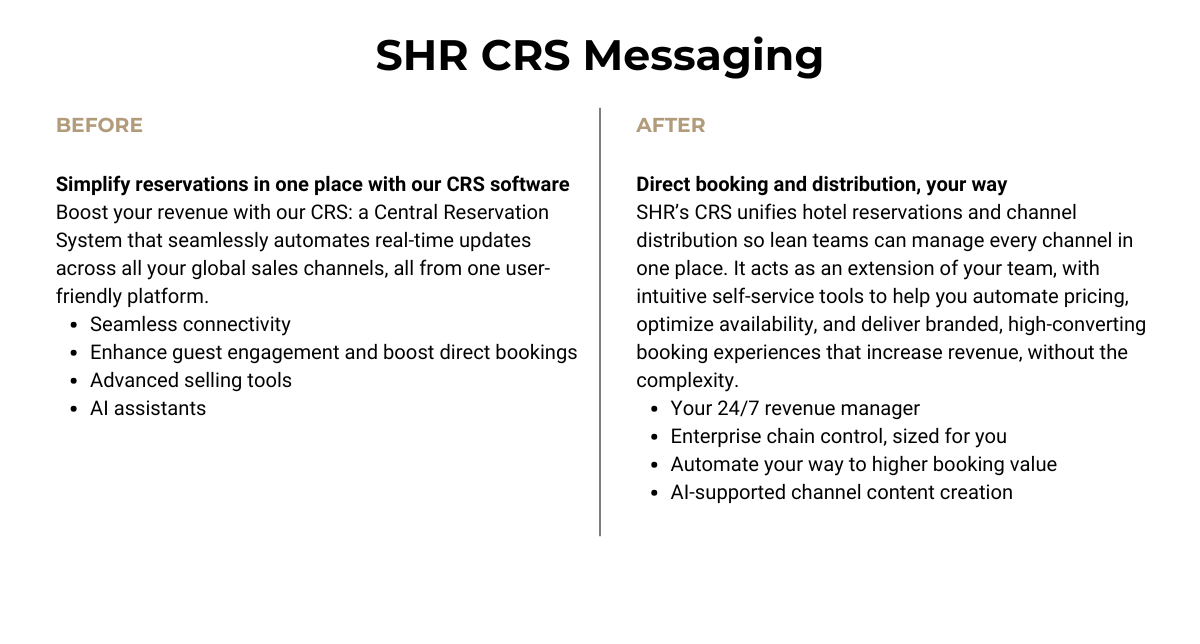
With positioning in place, we rebuilt the CRS messaging from the ground up. I created new headline concepts plus short and long descriptions that quickly communicate SHR’s difference: a CRS that feels like an extension of your revenue and distribution team. We broke the CRS into its component products, booking engine, channel manager, GDS, and voice applications, and wrote individual product descriptions so prospects could clearly see everything they get in a single solution.
We then defined a set of UVPs and supporting bullets centered on four pillars: extension of your team, enterprise‑level control, higher booking value through automation and AI, and scalable content and booking flows. Rather than simply saying “we have AI,” the messaging shows how SHR uses AI to support lean teams in practical ways, from automating routine tasks to optimizing booking flows.
Website
The first application of the new messaging was SHR’s CRS page. I partnered with the Digital Marketing team to translate the positioning into a clearer, more compelling web experience. The updated page now leads with the idea of doing it “your way” with SHR as an extension of your team, and it presents the CRS as more than a single system by clearly packaging the booking engine, channel manager, GDS, and voice together.
We introduced a tabbed value section that walks visitors through each UVP (team extension, enterprise control, revenue impact, scalable content, and optimized booking flows), so prospects can immediately understand how SHR addresses their day‑to‑day challenges. The booking engine’s role in driving higher‑value bookings and better guest experiences is woven throughout the page, connecting front‑end guest journeys to the intelligence of the CRS behind the scenes.
Value Proposition Deck
To make sure the CRS story lived beyond the website, I delivered a value proposition deck that included the positioning, messaging, a high-level competitive analysis, and the customer profiles for the SHR team to use across campaigns and sales enablement. The goal was to give SHR a consistent reference point for training and content creation across the organization.
Early response to the new CRS story has reinforced the strength of SHR’s positioning. Sales teams now have clearer language to describe the full value of the CRS bundle, and prospects better understand why SHR is different from design‑led, feature‑parity competitors. With a refreshed narrative that finally matches the strength of the product, SHR is better equipped to step out of the shadows and compete as the go‑to CRS partner for lean hotel teams.
“Jacki quickly became a trusted partner to stakeholders… What impressed me most was her ability to combine strategic thinking with strong execution. Every piece of Jacki’s work was grounded in deep customer and market research, and she has a real ease in translating complex product capabilities into clear positioning, messaging, and sales narratives that genuinely resonated with customers.”